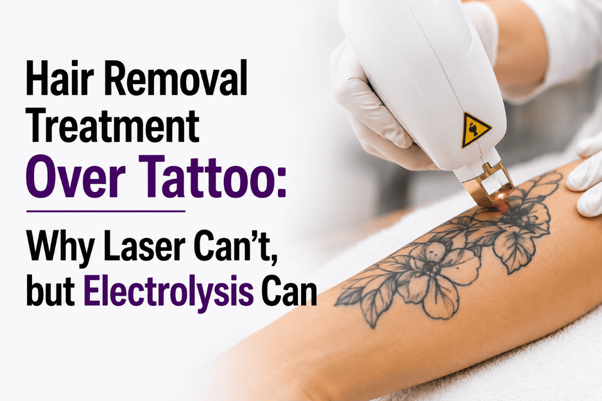
Unwanted hair can grow on skin that also has a tattoo. This can make hair removal feel confusing. The right method depends on how the treatment works, the hair, the skin, and the area being treated. Laser Hair Removal Over Tattoo needs extra care because tattoo-specific treatment rules are not the same as ordinary hair-removal treatment. Electrolysis takes a different approach by treating one hair follicle at a time.
Laser Hair Removal Over Tattoo: What Makes It Different
Laser hair removal and electrolysis do not work in the same way. Laser treatment works with the relationship between hair and skin. A strong contrast between the two can make laser treatment more suitable.
Electrolysis works inside the hair follicle instead. A fine probe enters the follicle, and a small electrical current is used to target the cells that produce hair.
This difference matters when hair grows near tattooed skin. It is also important not to treat every tattooed area in the same way. The skin, hair, tattooed area, and treatment needs should all be considered first.
Read More :- Electrolysis vs Laser Hair Removal: Which Option Is Right?
Why Laser Hair Removal Is Different Around Tattoos
Many people ask, why can’t laser hair removal be performed over tattoos? The answer needs care. Tattoo-specific laser rules are not covered in the available treatment details, so it would be wrong to make a blanket statement about every tattoo.
What is clear is that laser and electrolysis use different treatment principles. Laser treatment depends on light interaction with the hair and skin. Electrolysis does not need a big difference between hair and skin color.
For tattooed skin, a professional assessment is therefore important before choosing a method.
Can You Get Laser Hair Removal Over a Tattoo?
People often ask, can you get laser hair removal over a tattoo? The answer depends on the treatment area and the individual situation. Tattooed skin should not be treated based on guesswork. Before choosing a method, the hair, skin, tattooed area, and treatment needs should be reviewed by a trained professional.
Frequently Asked Questions
Q1: Can tattoos be protected during hair removal?
Protection depends on the treatment method and the tattooed area. A professional should assess the skin before treatment rather than relying on a general rule.
Q2: Does laser hair removal fade tattoos?
Tattoo-specific effects are not covered in the available treatment details. A tattooed area should be assessed before laser treatment is considered.
Electrolysis Over Tattoo: How It Works
Electrolysis Over Tattoo takes a follicle-by-follicle approach. The electrologist first finds the opening where the hair comes through the skin. A fine probe is then placed into the individual follicle.
A small electrical current passes through the probe. This targets the growth cells inside that follicle.
Because the treatment focuses on the follicle, it does not depend on hair color. Fine, coarse, light, and dark hair can all be treated.
There are three electrolysis methods used in treatment:
- Thermolysis
- Galvanic
- Blend
The right method is not presented as a fixed choice for every person. Treatment needs can differ from one person to another.
Why Electrolysis Can Treat Different Body Areas
Electrolysis can be used on many body areas. It is also suitable for different skin tones and hair types. This is useful for people who have hair that is difficult to treat with methods based on hair and skin contrast. It can also be useful for facial hair, sensitive areas, coarse hair, and unwanted hair linked with hormonal changes.
However, there is an important distinction for tattooed skin. A specific statement confirming treatment directly over tattoo ink is not available. Therefore, tattooed areas should be discussed during an assessment rather than treated based on an assumption.
Is Electrolysis Safe for Tattooed Skin?
Many people wonder if electrolysis is safe when hair grows on a tattooed area. The treatment uses a fine probe to reach each hair follicle and a small electrical current to target its growth cells.
Treatment is planned around the skin, hair, and treatment area. Tattooed skin should be discussed with the electrologist before treatment for proper assessment.
Frequently Asked Questions
Q1: Does electrolysis damage tattoos?
There is no tattoo-specific statement about this in the available treatment information. Tattooed skin should be discussed with the electrologist before treatment begins.
Electrolysis Hair Removal Treatment for Tattooed Skin
Before treatment, a consultation takes place. Hair-removal needs, hair type, skin, and the treatment area are discussed. An assessment can also determine whether electrolysis or laser is suitable.
The first session can be shorter. This gives the practitioner a chance to see how the skin reacts.
The treatment then follows a precise process:
- The hair follicle is located.
- A fine probe enters the follicle.
- A small electrical current is applied.
- The growth cells in the follicle are targeted.
- Additional sessions are planned because hair grows in cycles.
The Electrolysis Treatment Process
Hair does not all grow at the same time. Some hairs are active while others are in different growth stages. Because of this, several sessions are normally needed.
The amount of treatment depends on factors such as:
| Factor | What it affects |
| Hair growth cycle | When individual hairs can be treated |
| Treatment area | The time needed for each session |
| Amount of hair | The number of follicles requiring treatment |
| Hair texture | The type of hair being treated |
| Electrolysis method | The treatment approach used |
Consistent appointments are important. Repeated tweezing can also make treatment planning harder because hairs need to grow out so they can be treated.
FDA-Approved Permanent Hair Removal
Electrolysis is described as FDA-approved permanent hair removal. It works by treating individual follicles and targeting their growth cells with electrical current.
It can work across different hair colors and skin tones. This makes it different from treatments that rely on a strong contrast between hair and skin.
Preparation also matters. Tweezing, waxing, and depilatory creams should be avoided for at least two weeks before electrolysis. Shaving is allowed because it does not remove the follicle.
Why Hair and Skin Type Still Matter
Not every person has the same hair or skin. Curly and coarse hair can become trapped under the skin and contribute to ingrown hairs or raised bumps.
Dark skin also needs thoughtful treatment planning. Temporary redness, irritation, or hyperpigmentation can occur. Previous scars, piercings, or vaccination scars may also be discussed when there is concern about keloid formation.
After treatment, the area should not be touched too much. Sun exposure, tanning beds, and heavy sweating should also be avoided for the recommended period.
Safe Permanent Hair Removal for Tattooed Skin
Choosing a treatment is about more than removing visible hair. The method should suit the hair, skin, treatment area, and personal needs.
Electrolysis offers a direct follicle-based approach and is designed for many hair colors and skin tones. At the same time, tattooed skin needs individual consideration because tattoo-specific treatment rules are not universal.
Frequently Asked Questions
Q1: Which hair removal method is best for tattooed skin?
There is no single method for every tattooed area. The hair, skin, tattoo, and treatment area should be assessed before selecting an appropriate method.
Choosing a Top-Rated Electrolysis Clinic
A good treatment experience starts with proper assessment and skilled care. Look for trained professionals, strong hygiene practices, personalized treatment, and experience with different hair and skin needs.
Modern electrolysis equipment can also support precision and comfort. Professional memberships, continuing education, and experience add further confidence when choosing a practitioner.
Get Personalized Hair Removal Guidance
If unwanted hair grows on or close to a tattoo, do not choose a treatment based only on a general online rule. Electrolysis treatment process details can be discussed during an individual assessment.
Electrolysis Center Laser Hair Removal provides treatment planning based on the person’s hair, skin, treatment area, and individual needs. This personalized approach can make the next step clearer and more informed.
