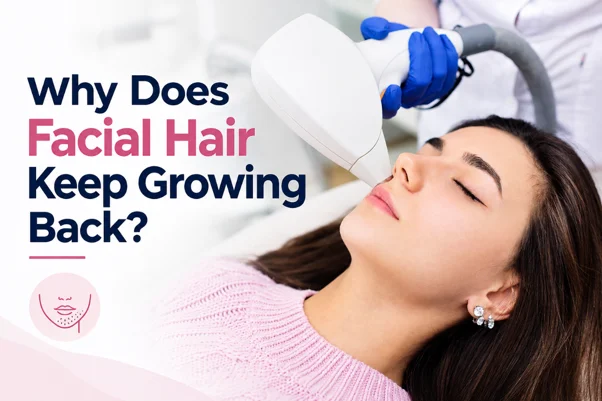
Facial hair can appear again after removal because each follicle follows its own growth cycle. While one hair is visible, another follicle may still be in a resting stage. Later, that hair can become noticeable. Understanding facial hair growth makes it easier to see why repeated removal does not always mean the same hair has returned.
Why Does Facial Hair Grow Back After Removal?
Hair grows in cycles. Not every follicle is active at the same time. Some hairs are growing, while others are resting. This is one reason why does facial hair grow back after removal is such a common question. One session cannot treat every hair that will become visible later.
You may notice new hairs between treatments because:
- Different follicles are at different growth stages.
- Some hairs were not visible during an earlier treatment.
- Hormonal changes can cause new unwanted hair.
- Temporary removal does not destroy the hair follicle.
With electrolysis, each available hair is treated as it enters a stage where it can be addressed.
Read More : Does Electrolysis Hurt? What to Expect During Your First Treatment
What Can Affect Facial Hair Growth?
Facial hair growth can change for many reasons. Puberty, menopause, pregnancy, genetics, some medicines, and certain health conditions can be linked with changes in unwanted hair. Hormonal changes are one factor. For example, some women notice new coarse hairs around the chin or upper lip.
If facial hair suddenly becomes much heavier or changes unusually, it is worth speaking with a doctor. An electrologist can treat unwanted hair but does not diagnose the reason behind a hormonal change.
Curly and coarse hair can also be more likely to become trapped under the skin. This can lead to ingrown hairs, bumps, irritation, or changes in skin color.
Why Do Temporary Hair Removal Methods Not Stop Growth?
Shaving, waxing, tweezing, and depilatory creams can remove unwanted hair, but they do not provide permanent removal of the follicle. Shaving cuts the hair at the skin surface. Waxing and tweezing pull the hair out, but the follicle can still produce another hair.
Long-term tweezing can also make it harder to see how much hair needs treatment. Some hairs have been removed before they could fully grow out.
That is why people often ask, “Why does facial hair grow back?” In many cases, it is simply due to the natural hair growth cycle or the use of a temporary removal method.
Can Electrolysis Permanently Remove Facial Hair?
If you are wondering whether electrolysis can permanently remove facial hair, the answer is yes. Electrolysis is designed for permanent hair removal by treating each follicle rather than simply removing hair from the skin’s surface.
Electrolysis can treat facial areas such as:
- Chin
- Upper lip
- Eyebrows
- Cheeks
- Neck
It can also treat light, dark, fine, and coarse hair across different skin tones.
How Does Facial Hair Removal Electrolysis Treatment Work?
The process starts with a consultation, where the electrologist checks the hair type and discusses the areas you want treated. The first session may be shorter to see how your skin responds. From there, each facial hair removal electrolysis treatment focuses on treating individual hair follicles one at a time.
The process includes:
- Finding the opening of the hair follicle.
- Placing a fine probe into the follicle.
- Applying a small electrical current.
- Destroying the growth cells inside the follicle.
- Removing the treated hair.
Three electrolysis methods are used: thermolysis, galvanic, and blend. The right approach depends on the person’s treatment needs.
How Many Electrolysis Sessions Are Needed for Facial Hair?
The number of sessions varies from person to person, so how many electrolysis sessions are needed for facial hair depends on factors such as the amount of hair, growth cycle, treatment area, and individual needs.
The number can depend on:
| Factor | Why it matters |
| Hair growth cycle | Hairs appear at different stages |
| Amount of hair | More hair can require more treatment |
| Treatment area | Areas differ in size and hair density |
| Hair growth pattern | Each person grows hair differently |
| Treatment method | Electrolysis methods can differ |
After years of tweezing, it can be even harder to know the full amount of hair at first. More hairs need to grow out before they can be treated. Regular appointments also matter. Consistent clearings and following the recommended schedule can keep treatment moving forward.
What Is the Best Treatment for Unwanted Facial Hair?
The best treatment for unwanted facial hair depends on the hair, skin, and area being treated. Temporary methods can be useful for short-term hair removal. Laser hair removal is another option for long-lasting hair reduction and works best on dark hair.
Electrolysis is different because it works inside each follicle and is designed for permanent hair removal. It can also treat hair of different colors. An individual assessment can help determine whether electrolysis or laser is the better fit.
How Does Facial Hair Removal Differ for Women and Men?
For women, unwanted facial hair often appears around the chin and upper lip, especially when hair growth changes. For men, treatment can focus on beard shaping, the cheeks, neck, neckline, or eyebrows. In both cases, the treatment is based on the amount and pattern of hair.
Read More : Electrolysis vs Laser Hair Removal: Which Option Is Right?
Find a Long-Term Approach to Facial Hair
If you are considering unwanted facial hair treatment, an individual consultation is a good starting point. Your hair type, treatment area, and removal history can all be considered before treatment begins. Electrolysis Center Laser Hair Removal provides personalized consultations for people who want a longer-term approach to unwanted facial hair.
FAQs
Q1: Why does facial hair keep growing back?
Facial hair grows in different cycles. Some follicles are active while others rest, so new hairs can become visible after a removal session.
Q2: How does the hair growth cycle affect facial hair regrowth?
Each follicle follows its own growth cycle. Because hairs are at different stages, several electrolysis sessions are often needed to treat hairs as they become ready.
Q3: Why does facial hair grow back after shaving or waxing?
Shaving cuts hair at the surface, while waxing removes it temporarily. Neither method permanently destroys the follicle, so another hair can appear later.
Q4: Does shaving make facial hair grow back thicker?
Shaving does not permanently change the hair follicle. Hair can feel different as it grows out, but shaving does not provide permanent hair removal.
Q5: Can facial hair growth be permanently stopped?
Electrolysis is designed for permanent hair removal. It treats individual follicles with a fine probe and electrical current to destroy growth cells.
Q6: What is the best long-term solution for unwanted facial hair?
Electrolysis is a permanent hair-removal option. It can treat facial hair of different colors and textures across different skin tones.
